How to Choose Bridal Wear That Reflects Your Style
A wedding outfit has a longer life than the wedding. It is in the portraits, the phone videos, the album someone opens twenty years later. That is why the pressure feels so loud: Pinterest boards, family WhatsApp groups, last year’s celebrity colour, a relative who “just knows” you should wear red.
Most of that noise is about looking like a bride. Very little of it is about looking like you in bridal clothes.
The outfits people remember are not always the heaviest or the most current. They are the ones that did not fight the person wearing them. If the blouse pinches, the colour drains you, or you keep tugging a dupatta that was styled for a studio and not for pheras, the camera records the struggle.
Choose bridal wear by stacking four filters, in this order — your real taste, the job of each function, what the clothes feel like after hour three, then trend. If a lehenga, saree or fusion piece fails the first three, it will not become “you” with better jewellery.
What “personal style” means on a wedding day
It does not mean repeating your weekend wardrobe in zari. A bride who lives in linen shirts can still want a structured lehenga. A bride who loves drama can still want a quiet ivory saree for the morning.
Personal style here means continuity. Someone who knows you should recognise you: the colours you already gravitate toward, the amount of surface decoration you can stand, the necklines you actually wear, the volume you feel at ease in.
If the outfit only works when you perform a different personality, it will photograph as costume. That is the gap between “beautiful on the rack” and “right on the day.”
A useful test: would you still like this silhouette if the embroidery were half as dense? If the answer is no, you may be shopping for spectacle, not for yourself.
Start with evidence you already own
Before you collect more inspiration, look at what you already choose when nobody is getting married.
Pull ten photographs in which you like your own face and posture — not celebrity stills. Ignore the occasion. Look for repeats:
- Do you reach for jewel tones or for softer, dusty ones?
- Do you prefer a clean neckline or a covered one?
- Do you like fabric that moves, or fabric that holds a shape?
- Do heavy earrings make you feel finished, or overdressed?
- Which outfits did you avoid all evening because of itch, slip or weight?
That pattern is more reliable than a mood board built from strangers under professional lighting.
Then write three sentences, not a thesis:
- I want to feel ______ (held / light / regal / simple / modern).
- I do not want to feel ______ (buried, itchy, trend-dated, unlike myself).
- The one family or cultural element I actually want to keep is ______.
That third sentence matters. Honouring tradition is not the same as outsourcing the entire look. You can keep a kanjeevaram, a red dupatta, a specific jewellery set, or a family blouse shape without accepting a silhouette you hate.
Give each event a job, not a Pinterest folder
An Indian wedding is a sequence, not one look. Shopping as if every function needs “the bridal treatment” is how brides end up exhausted and visually repetitive.
Assign a job to each outing:
| Event | What the clothes have to do | What usually fails |
|---|---|---|
| Haldi / mehendi | Survive colour, heat, sitting on the floor, hugs | Pale unlined fabrics, fussy drapes, heels you cannot stand in |
| Sangeet | Let you dance and raise your arms | Stiff can-can, tight blouses, dupattas that need a dresser |
| Ceremony | Hold up in ritual, family photographs, long sitting | Unstable pallu, neckline that gapes when you look down, weight that hurts by the pheras |
| Reception | Read clearly at night, across a room, in mixed light | Tiny motifs that vanish after 8pm, colour that goes muddy under tungsten, a train you cannot manage |
You do not need five equally heavy outfits. You need one or two pieces that carry the emotional weight of the wedding, and supporting looks that are lighter, easier, and still consistent with you.
A practical wardrobe often looks like this:
- Ceremony: the piece with the most meaning (saree, classic lehenga, family textile).
- Reception: cleaner structure or a different colour story, still related.
- Sangeet: movement first.
- Day functions: breathable cloth, less jewellery competition.
If budget is finite, spend it where the photographs and the rituals concentrate. Do not equally fund every event because a blog said you need a “trousseau story.”
Traditional, modern, or a third option
“Traditional versus modern” is a false exam if it forces you into a camp.
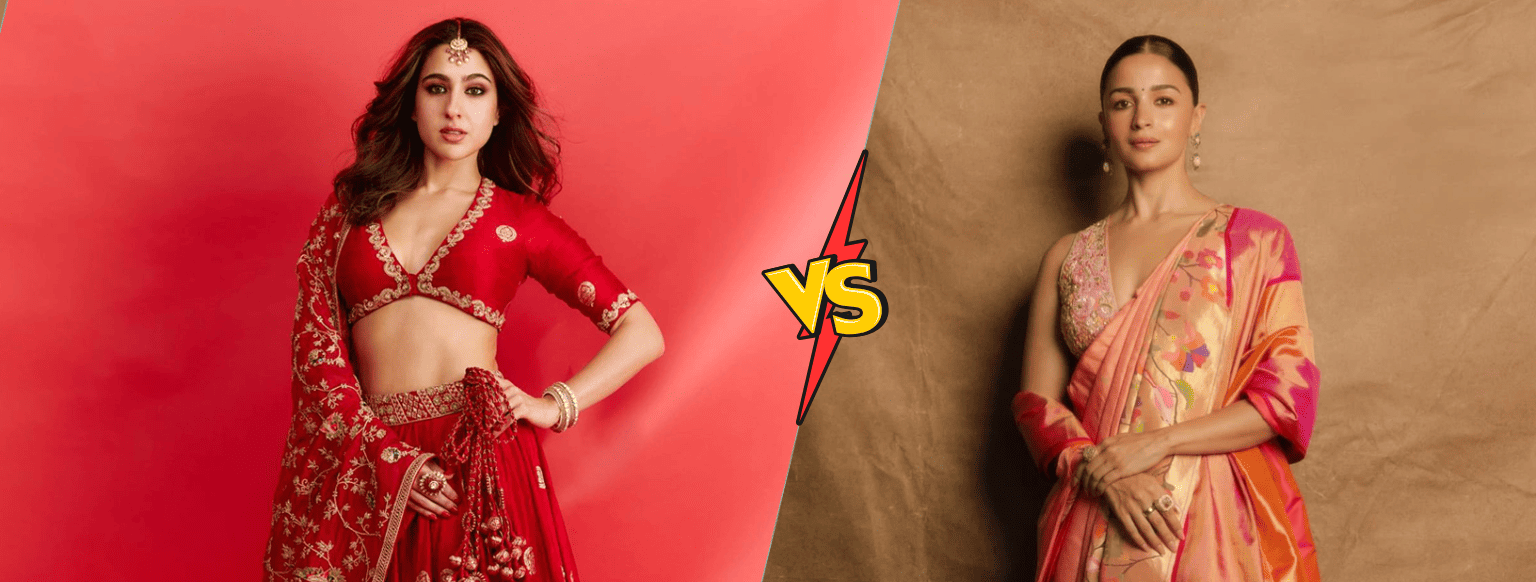
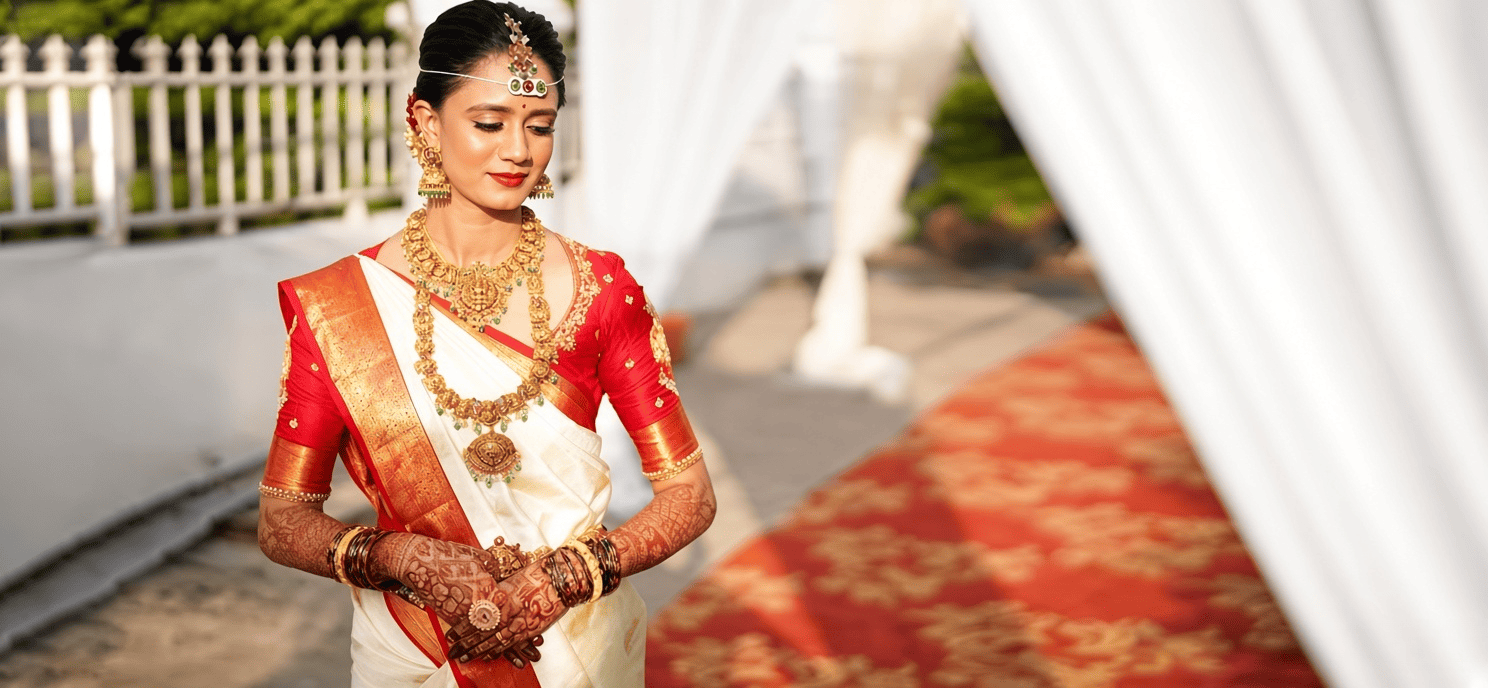
Traditional-leaning usually means recognisable heritage cues: reds, maroons, golds; silk and velvet; dense zari or zardozi; a saree or full lehenga; jewellery that would make sense to your grandparents.
Modern-leaning usually means a shift in one or more of those cues: ivory, champagne, blush, sage or unexpected jewel tones; lighter georgette, organza or crepe; negative space in the embroidery; a sculpted blouse, cape, gown or Indo-western cut.
Fusion that works changes one or two variables, not all of them. A red lehenga with a sharper blouse. A kanjeevaram with a contemporary drape. Pastel cloth with old family polki. A gown with Indian surface, not a Western dress with random motifs stuck on.
Fusion that fails is two outfits arguing: heavy bridal jewellery on a slip dress, or a novelty colour with so much gold that the “modern” brief disappears.
Traditional vs modern: what you are actually choosing
Traditional-leaning
- Strengths: reads instantly as bridal in family photographs; often photographs with depth; easier to explain to relatives.
- Trade-offs: weight, heat, limited rewear; can feel like a uniform if it is not cut for you.
Modern-leaning
- Strengths: often lighter; easier to move in; more room to look like your everyday self.
- Trade-offs: may need a stronger explanation at a ceremonial moment; some palettes wash out in harsh daylight or cheap banquet lighting; “current” details date faster than good cloth and good cut.
Neither is more correct. The better question is: which constraints does this wedding actually have? A temple ceremony with older relatives in the front row is a different design brief from a garden lunch or a hotel reception.
Venue and time of day should pull rank over trend:
- Hot outdoor day: organza, georgette, chikankari-level density, lighter lining.
- Winter indoor night: silk, velvet, more structure, colours that hold under warm light.
- Mixed: a breathable base with a dupatta or jacket you can remove.
Fabric is how the day will feel
Colour is what people comment on in the shop. Fabric is what you live in.
Ask what the cloth will do at hour six, not minute six.
- Silk (including kanjeevaram, banarasi, raw silk): authority, crease behaviour, ceremonial weight. Glorious if you want presence; punishing if you run hot or the function is outdoors at noon.
- Velvet: night, winter, structure. Poor choice for humidity.
- Organza and tissue: light and photogenic; need honest lining and a hem that does not cut.
- Georgette, chiffon, crepe, chinnon: movement, sangeet, travel, destination days.
- Net with heavy work: can look expensive in a still photo and collapse or scratch in real wear if the base and lining are cheap.
Bridal “regal” is often just stiffness plus gold. If your natural style is fluid, a lighter cloth with disciplined embroidery will look more like you than a board-stiff skirt you have to kick forward.
Lining, blouse finish and dupatta weight belong in this decision. An airy organza with a plastic-feeling lining will not feel modern. It will feel sticky.
Sit, walk, climb a step, raise both arms, and look down as if during a ritual. If the garment only behaves when you stand still for a mirror selfie, it is not ready.
Silhouette: stop theorising and try volume on a body
Lehenga, saree, sharara, Anarkali, gown — none is automatically more bridal.
What changes the photograph is where the volume sits and whether you can inhabit it.
- A-line / classic flare: the default for a reason. Balanced, familiar, easier to tailor.
- Kali / panelled flare: more drawing in the skirt, more movement if the panels are cut well.
- Fish-cut / mermaid: sharp in a reception; less forgiving for floor rituals and sitting.
- Sharara / gharara: length and divide must be exact or it looks messy in motion.
- Saree: unmatched for ceremony if you (or your dresser) can keep the drape; a pre-drape only feels like you if the pleats stay after you sit.
- Gown with Indian work: clear at a reception; confirm you still want that silhouette next to ceremonial clothes in the album.
Ignore rules that map body type to one silhouette (“petite brides should…”, “curvy brides should…”). Those shortcuts exist to sell faster. Try at least three shapes in similar colours. Watch your shoulders and walk, not only your waist.
The winning silhouette is the one where your face is still the point. If the first thing anyone sees is the can-can, the cut is wearing you.
Blouse shape is not a side note. Cape sleeves, high necks, deep scoops and structured cups change whether the look feels like you more than another row of sequins will. Choose the neckline you already live in, then elevate the cloth.
Colour: flattery, light, then politics
Red is a tradition, not a law. It is also not automatically “more bridal” on every skin tone, in every hall.
Choose colour in this order:
- Your face in that cloth, in daylight and in warm indoor light.
- The actual rooms — lawn, temple, banquet, night stage.
- Jewellery metal you already own or plan to wear.
- What you are willing to negotiate with family.
Jewel tones can look more expensive than pastels in a dim hall because they still read from a distance. Ivory and champagne can look luminous in morning light and grey under bad LEDs. Rani, maroon and deep green often hold. Some trending muted greiges simply vanish.
Do not pick a colour because it is “in” if it is a colour you have never once worn by choice. Trends recycle; your complexion does not.
If elders want red and you do not, a clean compromise is often red in one element — dupatta, blouse, border, or jewellery — rather than a full concession or a full fight. That is styling, not defeat.
Embroidery and weight are a stamina question
Dense zardozi, stone work and layered can-can look like “more wedding” in a boutique. They also have physics.
You will stand, bend, sit on low seating, hug, dance, and possibly walk in a baraat. Weight that is glamorous at the trial can become a headache by the reception.
Balance:
- If the skirt is heavy, keep the dupatta manageable or make it detachable.
- If the blouse is heavily worked, do not add a necklace that occupies the same real estate.
- If you want heirloom density, put it on the piece you wear for the shortest, most photographed window — not on the dancing outfit.
Handwork with some irregularity (chikankari, fine zardozi, thread work) often looks more expensive in person than perfectly even machine fill. Glue-on density photographs as shine and then sheds. If the brief is “this should still look like me in ten years,” buy construction and cloth first, motif volume second.
Make it yours in the quiet places
Full custom is not the only way to get a personal look. Small, stubborn choices do more than a slogan about individuality.
Worth changing, even on a ready piece:
- Blouse neckline and sleeve length
- Dupatta border placement
- Belt or no belt
- Lining colour under sheer zones
- Closure that actually matches how you will dress
- Hem for the shoes you will wear, not the sample heels
- One motif or family textile let into a blouse or pallu
Not worth changing just because you can: a colour you do not like, a silhouette you had to be talked into, or “more work” on a fabric that cannot carry it.
If you are briefing a karigar or boutique, bring your three sentences, photos of you, and the event job list. Do not bring forty disconnected screenshots. Designers cannot merge six brides into one.
A commitment checklist before you say yes
Run this before deposits and before family applause locks you in.
Taste
- Would I like this cut in a simpler fabric?
- Does this look like an elevated me, or like a template bride?
Day
- Can I sit, walk, climb, and raise my arms?
- What happens to the drape after ten minutes without a dresser?
Body
- Do the shoulders and blouse sit, or am I holding them in place?
- Is the waist where this silhouette needs it to be?
Senses
- Does it scratch, cling, or smell of finish?
- Can I wear it in this season’s weather?
Album
- Does the colour still look like itself in warm light?
- Will this read as me next to the rest of the wedding wardrobe?
Time
- Can handwork, blouse, and fittings finish without a panic week?
- Is there a plan for alterations that does not destroy a worked hem?
If you only love it on the mannequin, keep looking.
How early to start — without turning it into a second job
Heavily worked, made-to-measure bridalwear needs calendar space for cloth, embroidery, blouse trials and a final fit after jewellery and shoes exist. Starting many months ahead is ordinary for that kind of piece. A simpler ready ensemble still needs tailoring time.
What you should not rush: the blouse, the length, and the walk test. Those are where “almost” shows.
Two fittings beat one dramatic final reveal. Comfort is not a separate trend. It is why some brides look present in pictures and others look endured.
Trends are a menu
Pastels, botanical thread work, statement sleeves, detachable drapes, lighter Lucknowi surfaces, and reception gowns with Indian detailing are all in circulation because brides asked for less armour and more say.
Use them as options. Do not treat a year-labelled trend list as a requirement. The details that stay readable in an album are usually:
- a colour that likes your face
- a silhouette you can walk in
- cloth that still has a hand after the function
- jewellery that does not fight the neckline
- a relationship to tradition you can defend without a speech
The most dated wedding photographs are often the ones that followed a very specific micro-trend and ignored the person.
What not to outsource
Relatives can tell you what the community expects. They cannot tell you what your shoulders look like in that blouse.
Instagram can show lighting tricks. It cannot show the scratch of the lining.
A boutique can tell you what is selling. It cannot live the pheras for you.
Keep the decision rights. Take advice on craft, timing and family optics. Keep veto power on colour, weight and whether you recognise yourself.
When you find the piece, you will not need to be convinced. You will be able to move, sit, and stand in it without performing a different woman. That is the whole brief.
FAQs
How do I choose bridal wear that reflects my personal style?
Start with the colours, necklines and level of decoration you already choose. Match that to the job of each wedding event, then test fabric and fit in motion. Trends come last. If you only like the outfit in a studio mirror, it is not your style yet.
Should I choose a traditional or modern bridal look?
Choose based on the ceremony you are actually having, the weather, and how much heritage you want in the photographs — not based on which camp sounds more fashionable. Many strong looks are traditional in one element (colour, textile, jewellery) and contemporary in another (blouse, weight, drape).
Lehenga or saree for the main ceremony?
A saree often reads as ceremonial and photographs with lineage; a lehenga is easier for many brides to manage for hours if the blouse and waist are right. Pick the one you can keep in place during sitting, walking and rituals. A poorly secured saree is not more “authentic” if you spend the morning adjusting it.
How early should I buy a bridal lehenga or saree?
For heavy custom embroidery and multiple fittings, begin several months ahead. Ready pieces still need alteration time, especially blouses and worked hems. The scarce resource is not shopping — it is calm fittings.
How do I choose a bridal colour that suits me?
Test cloth against your face in daylight and in warm indoor light. Use colours you already look alive in, then adjust for venue lighting and jewellery. A trending pastel that greys you out is not a safer modern choice than a deeper tone that lights your skin.
Can I wear ivory or pastels for a traditional ceremony?
Yes, if you and the people whose opinion you have decided to honour can live with it. If red is non-negotiable for elders, consider keeping red in the dupatta, border or jewellery rather than abandoning your palette entirely.
How do I stay comfortable in bridal wear for long functions?
Prioritise lining, blouse fit, balanced embroidery weight and shoes that match the hem. Do a sit-walk-arms-up test. Detachable dupattas and lighter sangeet outfits exist because grandeur that cannot last the day is not grandeur.
What silhouette is most flattering?
The one that keeps your face as the focus and lets you move. Try classic flare, panelled skirts, sharara and saree on your body instead of following body-type rules. Fish-cut and gown shapes can be striking for a reception and awkward for floor rituals.
Should I follow bridal trends?
Borrow a trend only if it survives the taste and comfort filters. Quality fabric, a honest fit and a colour that suits you will outlast a seasonal motif.
How do I handle family pressure about the outfit?
Separate non-negotiables (a ritual colour, a family jewel, a modest drape) from preferences you can own (silhouette, density, blouse). Offer a specific yes — “red dupatta, my cut” — instead of a vague no. You still need veto power on anything you cannot wear for a full day.