Tips to Wear an Indian Saree at a Wedding
A wedding saree is easy to overbuy and easy to under-think. The pallu looks rich on a hanger. Then you sit for pheras, the blouse gapes, the silk does not move in the heat, or you realise you have arrived dressed more bridal than the bride.
The saree is not one garment. It is a length of cloth whose job changes with who you are that day: the person getting married, a sister, a guest at a temple, a guest at a hotel reception. Heritage weaves and contemporary organza can both be right. They are not interchangeable.
Direct answer: Choose in this order — the event and your role, the climate and venue, then colour, then weave or surface, then blouse and drape you can keep. Brides can carry denser silk, zari and jewellery. Guests should drop one level in weight and not match the couple’s announced colour. If you cannot sit, walk and raise your arms in it, it is not a wedding saree yet. It is a photograph.
Start with your role, not with the most expensive silk
The same Banarasi can look correct on a bride and aggressive on a cousin.
| You are | What the saree should do | What usually goes wrong |
|---|---|---|
| Bride (ceremony) | Hold ritual, family photographs, hours of sitting and walking | Unstable pallu, blouse that gapes when you look down, weight that hurts by the vows |
| Bride (reception) | Read clearly at night, across a mixed room | Tiny motifs that vanish after 8 p.m., a drape you cannot manage with a mike in your hand |
| Close family | Festive and coordinated, not bridal | Same red-and-gold density as the bride |
| Guest | Celebrate without competing | Heavy kanjeevaram plus full bridal jewellery set |
If the couple has published a palette, guests should use it as a boundary, not as a challenge. If you are the bride, you can ignore a trend colour that greys you out. Your face in the album is the brief.
Match cloth to the wedding you are actually attending
“Wedding saree” is not a fabric. A beach mandap, a Chennai temple, a winter palace and a Delhi lawn in May ask for different physics.
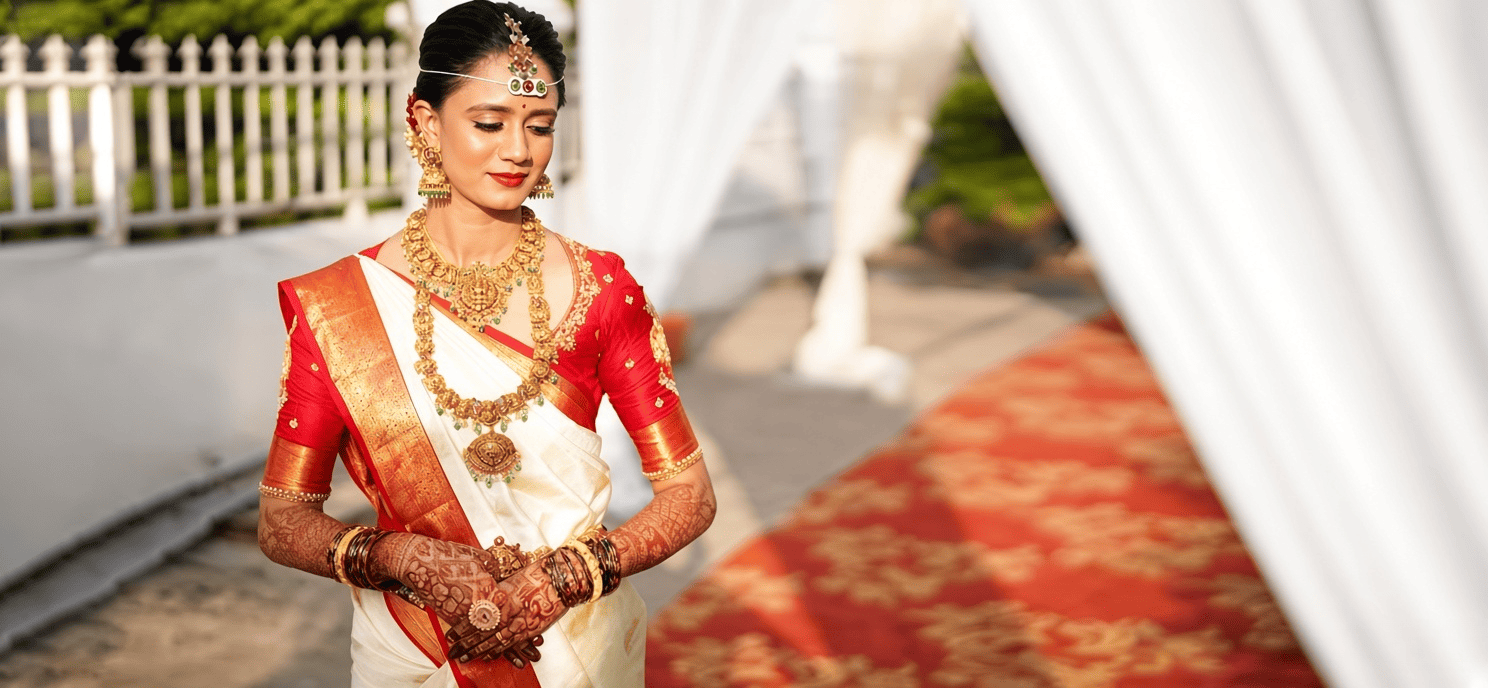
Ceremony, temple, traditional indoor. Structured silks earn their reputation here: Kanjeevaram (Kanchipuram), Banarasi, pattu, Paithani, rich handloom with a border that can take jewellery. They photograph with depth. They also hold heat. If the ritual is long and the hall is not cooled, a slightly lighter silk or a well-finished silk-blend with an honest fall is not a lesser choice.
Destination, outdoor, coastal, day. Chiffon, georgette, organza, tissue, crepe and lighter handlooms. Wind is real. A six-metre sail needs more pins than a boutique still. Organza and tissue look expensive in daylight; they need lining and a hem that does not cut.
Reception, cocktail, night hotel. More room for metallic, ombre, sequin fields, net-and-silk mixes, a sharper blouse. Night lighting kills dusty pastels and tiny motifs. Jewel tones and stronger borders still read from across a banquet.
Season. Summer and outdoor heat punish velvet, dense brocade and unlined heavy silk. Winter indoor nights can carry them. Monsoon and grass punish dragging hems and raw silk that spots.
Ignore body-type slogans (“thin women should wear stiff silk”). Try the fall on you. Stiff silk on someone who hates stiffness looks like endurance. Fluid cloth on someone who wants architecture looks unfinished. The drape and the blouse change more than a forum rule.
Colour: flattery, light, then family politics
Red is a tradition in many Indian weddings. It is not a law, and it is not automatically more bridal on every skin, in every hall.
Choose colour in this order:
- Your face, in daylight and in warm indoor light
- The actual rooms — temple, lawn, banquet, night stage
- Jewellery metal you will wear
- What you are willing to negotiate with relatives
Shades that still read as ceremonial in many contexts: red, maroon, rani, deep pink, gold-ground silks, auspicious yellows and greens depending on community. These are commonly chosen; they are not a moral ranking.
Softer and contemporary fields: blush, powder blue, mint, lavender, ivory-gold. Widely worn now, especially for receptions, mehndi-adjacent events and diaspora weddings. Test them under banquet LEDs. Some greiges simply vanish.
Deep jewel and off-script: emerald, navy, burgundy, chocolate, steel-gold. Strong in evening photographs. Confirm they do not collide with the couple’s colour if you are a guest. Black and stark white are the two most likely to need a local yes: some rooms treat them as evening-formal, others as the wrong signal for a morning ritual.
A useful guest rule: if the bride is in red-gold, do not arrive in a heavier red-gold. If she has claimed ivory, do not wear bridal-white.
You do not need a sacred-meaning speech for every hue. Wear a colour that likes your skin and the event. If elders want red and you are the bride who does not, a red blouse, red border or red jewellery on a quieter field is a real compromise.
Weave and surface: what the names actually buy you
The label on the pallu is not quality by itself. The hand, the border, the zari behaviour and the reverse are.
Kanjeevaram / Kanchipuram. South silk with a distinct border-and-body language, often a contrast border, substantial drape. A frequent ceremonial choice for South Indian weddings and for anyone who wants that weight in the photograph. Real pieces have a density you can feel; “kanjeevaram-style” prints on georgette are a different garment.
Banarasi. Brocade, floral and paisley jal, gold or silver zari on silk (and many blends). Reads festive from a distance. Check whether the zari is well seated or scratchy, and whether the silk has body or just shine.
Paithani. Distinctive Maharashtrian weave, often peacock and floral motifs, a different kind of border story. Heritage piece, not a generic “heavy silk.”
Uppada, chanderi, tissue, tussar, raw silk. Lighter or more textured ceremonial options. Tissue and organza need construction; they photograph like light and can collapse without lining.
Chiffon, georgette, crepe, organza (embellished). Movement, destination, reception. Embroidery and sequins here are only as good as the attachment. Glue-on glitter that looks dense in a thumbnail often sheds by the baraat.
Mixes. Silk blouse with georgette field, organza pallu on a crepe body, pre-stitched drape with a handloom blouse. Valid when one idea leads. Two competing “designer” ideas in one six metres look like a committee.
Handloom and mill, pure silk and blend, can all be wedding-appropriate. What you should not do is pay pure-silk money for a blend because the product title said Banarasi.
Authenticity without becoming a forensic lab
If you are buying “pure” Kanjeevaram, Banarasi or similar silk, ask for whatever certification and fibre detail the seller can actually produce. In India, Silk Mark is a known certification scheme for silk; it is not a substitute for looking at the cloth. A tag can be misused. The cloth still has to drape, the zari still has to sit, the colour still has to be even.
Practical checks, in person or from honest close-ups:
- Border and pallu joining: clean, or a rushed attach
- Zari on the reverse: controlled, or a nest of metal
- Cloth recovery after a fistful of fabric is crushed
- Colour at the fold, not only the studio centre
- Blouse piece: same family of cloth, or a leftover
- Smell of finish and whether it will sit on skin for eight hours
Online: zoom the pallu and the border, not only the model. Read whether the blouse is stitched, unstitched, or “as shown.” Return policies matter more for wedding silk than for a casual kurta because colour and hand cannot be fully known from a screen.
Budget: pay for what you will wear for hours
Price follows silk quality, metal in the zari, handwork hours, brand and whether the blouse is included. There is no single honest number. A guest georgette and a bridal kanjeevaram are different purchases.
Spend on:
- Cloth with the right hand for the venue
- A blouse that will be fitted, not a free extra that does not close
- Work that is stitched, not only glued, if you want it to survive the function
- Enough length for your height and the drape you use
Save on:
- Extra density the fabric cannot carry
- A second ceremonial silk you will not drape because the first already exhausted you
- Matching jewellery sold as a set with the saree if you already own metal that works
If the budget is tight, one excellent drape plus a fitted blouse beats three mediocre “wedding” sarees in slightly different pinks. Guest wardrobes especially benefit from one strong silk and one lighter reception piece rather than five similar heavies.
The blouse is not a leftover
Wedding photographs fail at the blouse as often as at the pallu.
Ceremony blouses usually need:
- A neckline you can bow and sit in without gape
- Sleeves that match the family’s expectation of coverage (ask; it varies)
- Structure at the bust so the silk has somewhere to sit
- A back you can accept in a crowd of aunties with phones
- Fabric that can take the saree’s weight at the pin points
Reception blouses can go sharper: sweetheart, slightly lower back, contrast cloth, elbow sleeve, even a well-cut sleeveless if the event is clearly not a temple morning. Halter and deep-back cholis belong to drapes and rooms that support them, not to a windy outdoor pheras.
Do not leave the blouse unstitched until the week of the wedding if the saree is heavy. The blouse is the engineering. Made-to-measure on the blouse is often worth more than another row of stones on the pallu.
Pre-draped and stitched sarees need an equally serious blouse. A crop that looked modern on a mannequin can fight a ceremonial pallu. Try them together.
Drape for a function, not for a tutorial still
Nivi — tucked around, front pleats, pallu over the left shoulder — is the default because most people can walk in it. Wedding nivi is tighter, better pinned, and hemmed for the shoes you will wear.
Before the pallu:
- Petticoat that actually grips after food. Drawstring plus, if needed, a belt.
- Blouse on, hooks that close, arms tested.
- Tuck from the right, one full round, lower edge just at the floor in those shoes.
- Front pleats even, width you can sit in, tucked slightly left of centre, pinned.
- Pallu over the shoulder, length you can control, pinned through pallu and blouse.
- Optional hip pin so the tuck does not walk during jaimala.
Practise once in the jewellery. Maang tikka and a heavy necklace change how you hold your head and how the pallu behaves.
Other drapes, if they are yours:
- Gujarati / seedha pallu: pallu displayed in front. Makes sense when the pallu is the point of the weave. Needs a secure waist.
- Bengali-influenced double wrap: more cloth in play; elegant if you know it, messy if you do not.
- Nauvari / Maharashtrian dhoti-style: movement for rituals if it is a drape you already inhabit. Not a Sunday experiment on the mandap.
- Pre-stitched: valid for destination weddings, nervous first-time wearers, and anyone who wants to be present instead of negotiating pleats. It only looks expensive if the stitch holds after you sit.
Do not learn a new regional drape on the wedding morning because a reel said it was more authentic. A slipping pallu is not heritage.
Jewellery, hair, shoes: hierarchy
The saree already occupies space. One area should lead.
- Heavy weave: quieter jewellery, or jewellery in the same metal family as the zari, not a second competing bridal set if you are a guest
- Plain field: earrings or a necklace can take the job
- Hair off the pallu pin; flowers if they mean something, not if they shed onto silk
- Heels only if you can stand in them for rituals; block heels and well-made juttis are not a lesser look
- Makeup that survives heat; the saree should not be fighting a sliding bindi all evening
Maang tikka, nath and heavy bridal sets signal bride in many rooms. Guests should be careful with that vocabulary.
Common mistakes
- Buying the saree for the hanger, the blouse the week of
- Guest in the bride’s colour and density
- First-time organza in wind
- Pallu so long it becomes a trip hazard at the fire
- Ironing zari on high to “crisp” it
- Perfume on silk before a closed mandap
- Assuming “silk” on the title means the same hand as a known weave
- No spare pins, no safety pin that matches the cloth
- A drape so tight you cannot sit for the pheras you came to sit for
A short buying sequence
- Name the event and your role.
- Name the heat and the floor (marble, grass, sand, carpet).
- Shortlist two colours that like your face.
- Shortlist one ceremonial cloth and, if needed, one lighter reception cloth.
- Fit the blouse as seriously as the saree.
- Drape, sit, walk, raise arms, put on the bag.
- Only then talk jewellery.
The wedding saree that still looks right at the end of the function is the one whose pallu is still where you left it, whose blouse still closes, and whose colour still looks like your colour in the last photograph. Heritage is in the weave if the weave is real. Presence is in the fit.
FAQs
How do I choose a wedding saree?
By role and event first, then climate, colour, weave and a blouse-drape combination you can keep. Bridal ceremony can carry dense silk and zari. Guests should go one step lighter and avoid the couple’s claimed colour.
Which saree is best for a South Indian temple wedding?
A well-finished Kanjeevaram or similar silk with a border that can take jewellery is a classic ceremonial choice. Comfort still matters: if the ritual is long and hot, a slightly more wearable silk with the same language of border and gold often looks better than a stiff piece you cannot sit in.
Can guests wear Banarasi or Kanjeevaram?
Yes, at a lower density than the bride and not in her exact colour story. A lighter Banarasi or a quieter silk is usually more correct than a second bridal.
What colour should a bride wear?
The colour that likes her face in the actual light, that her ceremony can live with, and that she will not resent in photographs. Red and maroon remain widely ceremonial; ivory, pastels and jewel tones are common too. Family expectation is a negotiation, not automatically a veto of every other shade.
Which fabric for a destination or outdoor wedding?
Georgette, chiffon, organza, tissue or lighter handloom, with enough lining and pins for wind. Heavy unlined silk on a beach at noon is a stamina test, not a look.
How do I know if a silk saree is authentic?
Ask for fibre detail and any silk certification the seller claims, then judge the cloth: drape, border join, zari reverse, colour at the fold. Titles like “Banarasi” and “Kanchipuram” are used loosely online. Close-ups and return policies matter.
What blouse should I wear with a wedding saree?
One that closes, covers what the event requires, and can take the pallu pin. Ceremony: more structure and usually more coverage. Reception: more room to be contemporary. Fit the blouse early.
How do you drape a saree for a wedding so it stays?
Firm petticoat, even front pleats, pallu pinned through the blouse, optional waist pin, hem for the real shoes. Practise once with jewellery. Do not debut a new regional drape on the day.
Are pre-stitched sarees acceptable for weddings?
Yes if the stitch holds after sitting and the blouse is as considered as the cloth. They are often the difference between being in the ritual and managing fabric.
Can I wear a designer or contemporary saree to a wedding?
Yes when the event is a reception, cocktail or a clearly modern ceremony, and when the finish is high enough. A novelty drape with poor cloth still looks like a novelty. Match the room: temple morning and hotel night are different briefs.