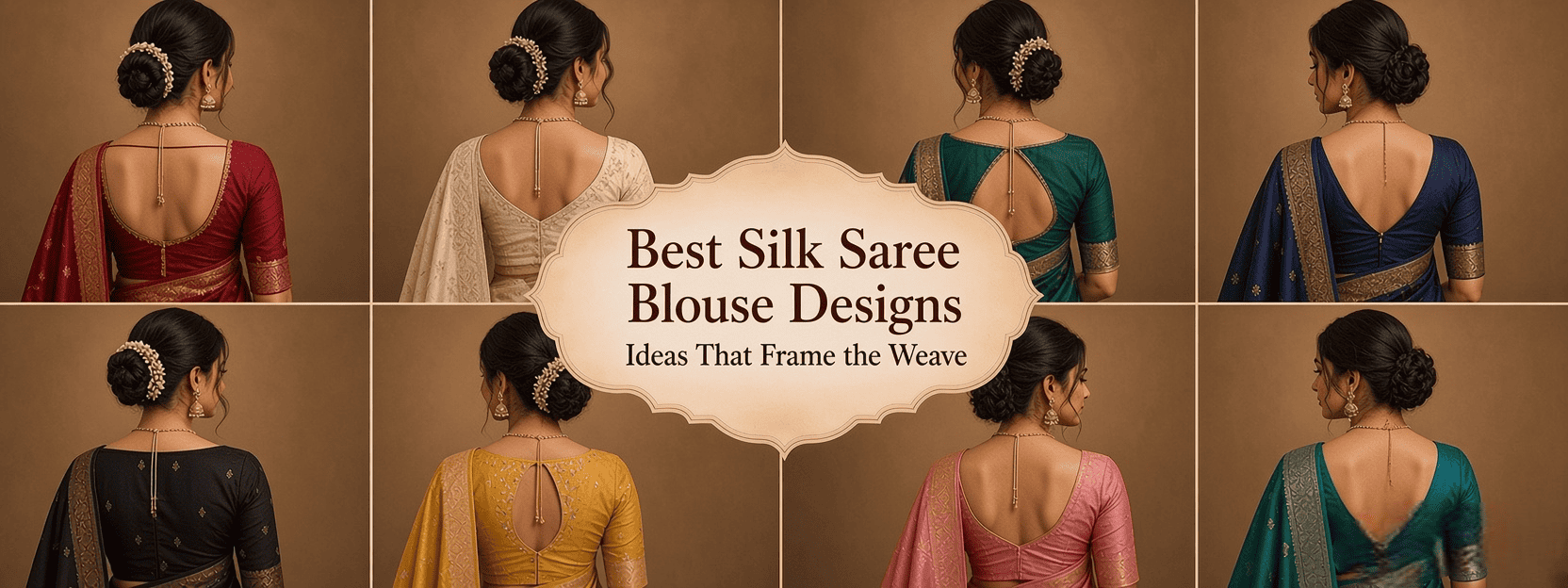
Best Silk saree blouse designs ideas that frame the weave
A silk saree already has weight, sheen, and often a border that does half the talking. The blouse either gives that cloth a frame, or it starts a second conversation the pallu cannot win.
That is why copying a heavily worked blouse from a chiffon or georgette look onto a Kanjeevaram so often fails. The question is not “which of 28 designs is trending.” It is: how loud is the saree, how open is the neck, how long is the event, and where should the eye stop.
This is a working guide to silk saree blouse designs grouped by the decision you actually make at the tailor, with notes on when a cut helps and when it only adds heat and bulk.
Start with the saree, then pick a blouse idea
Silk is not one fabric. A dense Kanchipuram, a brocade Banarasi, a Paithani pallu, a light Mysore, and a slubby tussar all ask for different blouses.
Use this order:
- How busy is the saree? Heavy jaal, thick zari, pictorial pallu → quieter blouse. Plain or lightly bordered silk → the blouse can take a stronger neck, sleeve, or back.
- How heavy is it to wear? A structured silk already sits away from the body. A huge puff plus a stiff brocade blouse can feel like armour by hour two.
- What will show? Pallu on the shoulder hides some of the back. A Gujarati or loosely draped pallu shows more blouse. Plan the back for the drape you will actually use.
- What jewellery is non-negotiable? Temple set, choker, long haar, or earrings-only changes the neckline more than any “2025” list.
If you only stitch one blouse for several silks, stitch a well-fitted solid in a colour that already appears in two sarees. Fancy one-off blouses are for sarees that cannot share.
Necklines that behave next to silk
The neckline is the first line people see when the pallu is on the shoulder. Keep it architectural. Silk sheen next to a messy neck looks unfinished.
Round neck. The default. Clean under a heavy border, easy with a haar, kind to most ages. On a rich silk it often needs nothing but a good bind or a narrow zari edge.
Boat neck. A wide, shallow line across the collarbones. Excellent when you want the saree to feel slightly more contemporary and you like earrings more than a long necklace. Do not cut it to the shoulder bone or it will slide under the pallu. Stay tape matters on silk.
Square neck. Sharper than a round neck. Gives structure to a plain silk or a Mysore-style body. A little edge finish is enough; a square already has a graphic quality.
U-neck. Softer open shape. Useful if a round neck feels too closed and a V feels too sharp. Keep the depth modest on a conservative function; silk does not need a plunging U to look expensive.
V-neck. Lengthens the torso. Works when the silk is plain or the jewellery is a pendant. A very deep V plus a heavy bridal silk plus a temple necklace is usually too many verticals. Moderate V, clean bind.
Sweetheart. A curved, slightly romantic line. Pairs well with a softer silk or a reception look. On a very traditional Kanchipuram it can look like it belongs to a different outfit unless the rest of the styling is also softened.
High neck / closed collar. Formal, covered, good under winter silk and for people who want less chest on display. The risk is stacking: high neck + choker + maang tikka + heavy pallu. If the blouse is high, keep the necklace short or skip it and let earrings work.
Collar / band collar. Adds a shirt-like or jacket-like finish. Strong with a plainer silk and a modern drape. Weak if the saree border is already a wide gold frame — two collars, one of them textile.
Halter. Shows shoulders, needs a secure inner and a pallu that will stay. Better for lighter silks, pre-draped sarees, and indoor events than for a windy outdoor wedding in heavy silk.
Keyhole. A small opening at the front (or back). Controlled detail. Works on silk because you can keep the rest of the neck plain. Size the hole; a keyhole that stretches looks accidental.
Peter Pan collar. A rounded, slightly vintage collar. Cute on a lighter silk or a younger, daytime festive look. Next to dense Banarasi brocade it can feel costume-like unless the blouse fabric is equally serious.
Spaghetti straps on a heavy silk are a gamble. The saree has mass; two thin straps have to hold a lined blouse and often a bra. If you want less sleeve, a stable sleeveless with proper facing is usually more honest than straps that cut in.
Sleeves: silk already has volume — do not always add more
Sleeves change formality faster than embroidery.
Sleeveless. Heat, bangles, printed or contrast blouses. Finish the armhole as carefully as the neck. A raw sleeveless silk blouse looks cheap next to a good weave.
Cap and short sleeves. Everyday-to-festive middle. Easy on cotton-silk and lighter silks; still fine on Banarasi if the neck is quiet.
Elbow and three-quarter. Polished without full coverage. Good for functions where you will eat and gesture. Embroidery on the sleeve sits well here because it shows when you move.
Full sleeves. Winter, evening, conservative settings, bishop or straight. On heavy silk, keep the sleeve from being both tight and heavily worked — you need to bend your arm.
Puff and gathered heads. Fashion without covering the blouse in zari. Moderate puff on a solid silk blouse next to a plain or contrast-border saree. Large puff plus large border plus large earrings is a crowd.
Bell, butterfly, flutter. Movement. They photograph well and catch in jewellery and pallu. Use on lighter silks or when you will not be serving food.
Bishop sleeves. Full, gathered into a cuff. Regal if the silk blouse fabric has drape. Uncomfortable if the cuff is tight and the saree is already hot.
Cold shoulder and off-shoulder. Contemporary, and they need a pallu strategy. Off-shoulder with a traditional heavy silk often looks like two outfits stacked. They work more often with lighter silks, reception drapes, and hair up. If the cut is sloppy, they look unfinished, not daring.
Match sleeve volume to how quiet the neck is. One area leads.
The back is where a silk blouse can take a risk
Front boat or round, interesting back, is one of the most wearable formulas for silk. You see the front while draping; others see the back when you walk, unless the pallu covers it.
Useful backs:
- Closed, same as front — safest with a heavy pallu and conservative events
- Buttoned placket — quiet vintage, good buttons beat extra embroidery
- Dori / tie-up — traditional, adjustable, classic with silk
- Keyhole — small statement
- Deep U or V — only if the pallu will stay put and you want that skin; poor in wind
- Sheer panel — evening silks; keep the front opaque
- Jacket or overlay back — extra layer; consider climate
A deep back and a heavy silk pallu fighting for the same shoulder is a common wedding-guest failure. If you need the pallu anchored, do not cut the back away.
Surface work: frame, do not re-weave the saree
Silk saree blouse designs get overworked because the saree feels “special,” so the blouse is made equally special. Two specials cancel.
Details that usually help:
- Narrow zari, gota, or piping that follows the neck and armhole
- A Banarasi or brocade blouse left plain at the neck, so the fabric is the decoration
- One line of beads or cut-dana on the edge
- Embroidery on sleeves or a yoke, not on every princess seam
- Lace as a sleeve or a neck insert, with a lined bust
- Mirror or gota as a thin border of light, not a full disco yoke
- A contrast bind that picks a colour from the border
Details that often fail on silk:
- Full sequin coverage on a blouse and a zari jaal saree
- Heavy front embroidery that sits under a haar and disappears, leaving only bulk
- Sheer unlined silk that wrinkles across the bust in photos
- Random patches of work that do not follow the cut
Zari work blouses belong next to a plainer silk, or as a border on a solid. Matching a Kanjeevaram inch-for-inch in extra zari is how outfits start to look costumed.
Embroidered blouses (thread, floral, geometric) are a good way to add art without competing with woven gold — especially on tussar, raw silk, and simpler mulberry.
Lace and sheer need construction: lining, stay tape, and a neckline that does not gape. They suit reception silks more than a temple Kanchipuram, unless you are deliberately mixing.
Jacket-style blouses (a short overlay, open front, or structured jacket cut) add formality and coverage. They work on winter silk and on people who want sleeves without a tight armhole. They add heat. Make the inner blouse as finished as the jacket; it will show.
Colour and blouse fabric
The blouse does not have to match the saree. It has to agree with it.
- Same-family solid — calm, lets the weave show. The most reusable choice.
- Contrast from the border — deliberate and often better than a near-miss match.
- Black, navy, ivory, maroon, old gold — sit under many festive silks.
- Bright blouse — pulls the eye up; useful if the silk is dark or quiet; chaotic if the silk is already loud.
Fabric weight should be in the same “temperature” as the saree:
- Brocade / heavy silk blouse under Kanjeevaram or Banarasi
- Raw silk or satin-silk under medium weaves
- Softer silk or well-lined georgette only if the saree is light
- Velvet for winter evenings, clean cut, little extra ruffle
- Cotton blouse under heirloom silk often looks underdressed unless the silk is casual tussar and the event is daytime
A flimsy blouse under a dense silk makes the whole drape look top-light. A stiff embroidered jacket under a fluid light silk can look disconnected.
Pairing by the silk you actually own
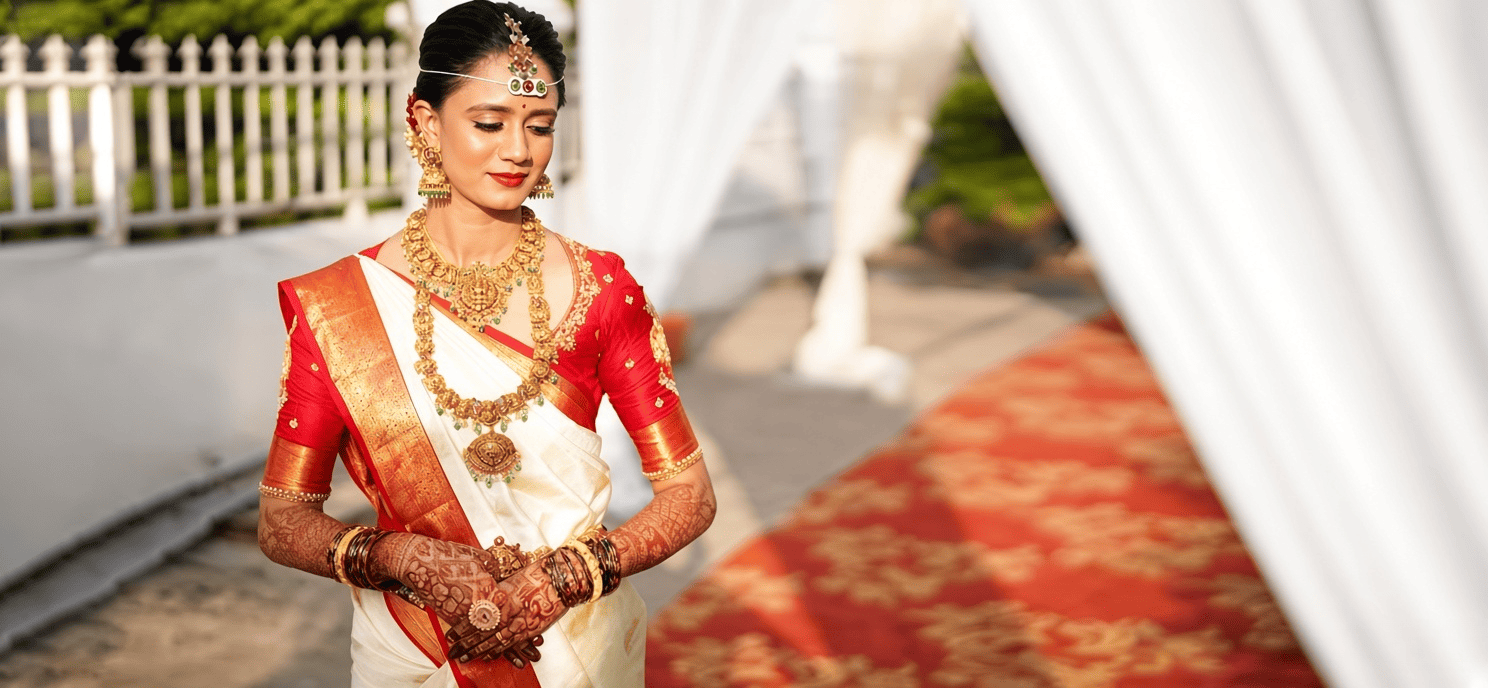
Kanjeevaram / heavy temple silk. Quiet neck (round, boat, modest U), solid or contrast from the border, sleeve you can sit in, back that allows the pallu to sit. Jewellery is already traditional; do not add a second gold story on the blouse.
Banarasi brocade. Same logic if the jaal is dense. If the Banarasi is lighter organza or a plain katan with a border, you can add a stronger sleeve or a keyhole back.
Paithani. The pallu is the picture. Plain blouse, good colour, let the peacock or lotus land when you drape.
Mysore and other plain-body silks. This is where boat necks, square necks, puff sleeves, a collar, or a bit of lace earn their keep.
Tussar and textured silks. Embroidery, thread work, simpler cuts, duller metals. Heavy bridal zari on the blouse can fight the earthy yarn.
Light silk, organza-silk, party silk. Halter, off-shoulder, sheer yokes, bell sleeves — if the event and the pallu allow. Construction still has to be solid.
A compact menu of ideas (without 28 identical paragraphs)
If you like a list to take to the tailor, these are the cuts worth considering. Pick one neck, one sleeve, one back, one surface. Not all four at maximum.
| If you want… | Try… | Skip if… |
|---|---|---|
| Maximum reuse | Round or boat, short or 3/4 sleeve, solid silk | You only wear this with one bridal saree |
| Formal coverage | High neck or collar, full sleeve | You also want a heavy choker |
| Shoulder line | Boat or square, cap or sleeveless | Very wide cut with no shoulder left |
| Lengthening | Moderate V or U | Deep V + temple haar + heavy pallu |
| Soft / reception | Sweetheart, lace, sheer yoke | Temple function, conservative family |
| Vintage volume | Puff, bishop, or jacket blouse | Heat, long day, already-stiff silk |
| Movement | Bell, butterfly, flutter | Serving food, catching zari |
| Back interest | Buttons, dori, keyhole, sheer panel | Pallu must stay pinned on that shoulder |
| Modern fusion | Halter, cold shoulder, off-shoulder | Heavy heirloom silk, outdoor wind |
| The saree is plain | Embroidery, zari border, contrast piping | The saree is already a full jaal |
That is more useful than twenty-eight separate “perfect for weddings” captions.
Fit and construction on silk specifically
Silk shows every ripple. A cotton trial (muslin) is worth it if the neckline is new.
- Stay tape or a firm facing on boat, square, and wide U necks
- Proper darts or princess seams; silk will not hide a badly placed bust
- Lining on light colours and on anything sheer
- Hooks that can take the strain of a heavy pallu tug
- Armhole you can lift — you will adjust the saree all evening
- Blouse length that meets the petticoat without a gap that looks accidental
Do the blouse (or at least the trial) before you lock jewellery. A high neck decided after the choker is bought is how people look crowded.
Common mistakes
Matching a busy blouse to a busy silk because both were “for the wedding.”
A deep back with a pallu that will not stay.
Off-shoulder on a Kanjeevaram because a celebrity wore it on georgette.
Puff sleeves, ruffled neck, and zari all over — no rest for the eye.
A spaghetti-strap blouse under a six-pound silk.
Near-matching the saree colour and missing, so it looks faded rather than contrast.
Doing heavy embroidery first, then discovering the boat neck is too wide to wear.
How to brief the tailor
Take the saree, or photos of pallu, border, and body. Say, in this order:
- Occasion and how the pallu will be draped
- Neckline height and width (show on your collarbone)
- Sleeve length and how much volume
- Back: closed, buttons, dori, keyhole, or open
- Surface: none / piping / border / embroidery where
- Blouse fabric and lining
- Jewellery you will wear
Ask for a cotton trial before zari or embroidery. Changing a silk boat after it is worked is expensive and usually ugly.
A silk saree blouse design is doing its job when you forget it after the first hour — not because it is boring, but because it is stable, the neckline agrees with the jewellery, and the weave is still the main object in the room.
If you are stitching next, start with the saree on a hanger: busy or quiet, heavy or light. Choose a neck that leaves the collarbone either clearly shown or clearly covered. Add at most one extra idea — a sleeve, a back, or a border of work. That blouse will be worn with more than one function. The complicated one can wait until this shape is proven on you.
Frequently Asked Questions
Which blouse is best for a silk saree?
A well-fitted solid in a round, boat, or modest U-neck, with a sleeve you can sit in. That combination works with the most weaves. Decorate only if the saree is plain.
Should the blouse match the silk saree exactly?
Not necessarily. A related solid or a colour pulled from the border often looks more expensive than a near-miss match. Exact match is fine when the cut is excellent and the silk is the star.
What neckline suits a Kanjeevaram or Banarasi?
Round, boat, square, or a moderate U. Keep it clean. Let the border and pallu lead. Save plunging or off-shoulder cuts for lighter silks unless you are sure of the drape.
Do puff sleeves work with silk?
Yes, on a quieter saree or a plain-body silk. Keep the puff moderate if the silk is already stiff or the jewellery is heavy.
Can I wear a sleeveless blouse with silk?
Yes, especially in heat. Finish the armhole well. A stable sleeveless cut is usually better than thin straps under a heavy saree.
What back design works if I need the pallu on my shoulder?
Closed back, shallow keyhole, or a buttoned placket. Deep U, backless, and very open jackets fight a anchored pallu.
Which blouse colour makes a silk saree look richer?
Contrast that already exists in the border, or a deeper related tone. Random bright contrast can look stylish or chaotic depending on the jewellery. When unsure, a deep solid is safer than a loud mismatch.
Is a high-neck blouse good for silk?
It is, when you want coverage and a formal line. Skip a heavy choker, or keep the blouse neck simpler. High neck plus full traditional jewellery plus a thick gold border is a lot of frames around one face.
Should the blouse fabric also be silk?
For heirloom weaves, a silk or brocade blouse in similar weight usually looks right. Tussar and daytime silks can take raw silk or even a refined cotton. Avoid a flimsy blouse under a dense weave.
How do I make one blouse work with several silk sarees?
Solid colour that appears in more than one saree, classic neck, unfussy sleeves, no scene-stealing embroidery. Contrast piping in a neutral (gold, black, ivory) extends the range.