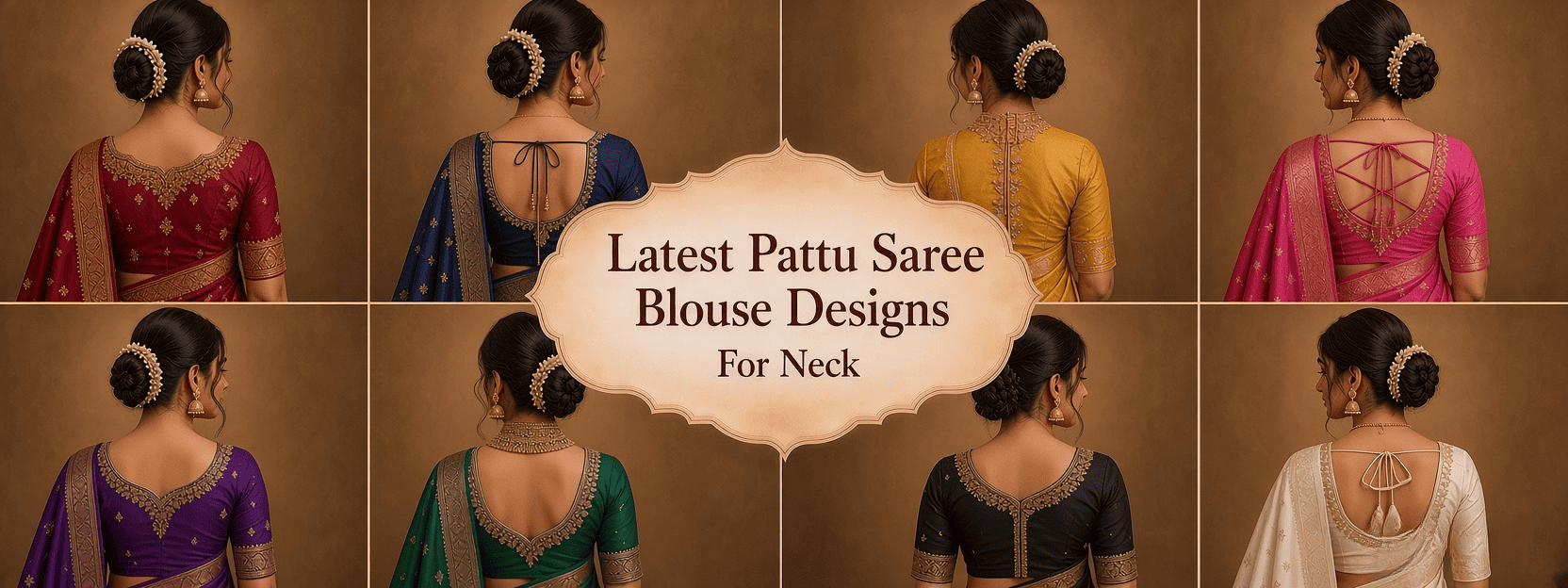
Latest Pattu Saree Blouse Designs For Neck, Front and Back
A pattu saree already has weight, sheen, and usually a border that does a lot of the talking. The blouse either gives that silk a clean frame, or it starts a second conversation the pallu cannot win.
“Pattu” is the South Indian word most people use for silk Kanjeevaram, other Kanchipuram-style silks, Mysore, and similar ceremonial weaves. The blouse rules are closer to heirloom silk than to a light georgette: the cut has to sit still, the neck has to agree with the jewellery, and “latest” only helps if it still works after three hours of sitting.
This is a working guide to pattu saree blouse designs necklines first, then front and back, then the simple versions worth stitching more than once.
Start with the saree, not a trend name
Before you pick boat neck vs high neck, look at the cloth.
How busy is the body and pallu? A dense zari jaal or a heavy contrast border wants a quieter blouse. A plainer pattu with a thin gold edge can take a stronger neck, sleeve, or back.
How will you drape? Pallu on the left shoulder hides part of the back. A more open drape shows the blouse from behind. Design the back for the drape you will actually use.
What jewellery is fixed? Temple set, choker, long haar, or earrings only. A high neck plus a heavy choker plus a thick gold border is three frames around one face.
How long is the day? Pattu is already warm. Huge puffs, a jacket layer, and full zari on the blouse add heat. Save volume for a shorter evening if the function is long.
If you stitch only one blouse for several pattu sarees, make it a well-fitted solid that picks a colour already in two borders. The decorative one-off can wait.
Neck designs that sit well on pattu
The neckline is what people see when the pallu is on the shoulder. On silk, a messy or too-wide neck looks cheaper than a plain, well-bound one.
Round neck. The most useful default. It sits cleanly under a heavy border and a haar. On a rich pattu it often needs nothing but a firm facing or a narrow zari or contrast bind.
Boat neck. A wide, shallow line across the collarbones also called bateau. It looks considered and slightly more contemporary, and it favours earrings over a long necklace. Do not cut it to the shoulder bone or it will slide when you lift the pallu. Stay tape on silk is not optional. Leave fabric on each shoulder.
High neck / closed collar. Formal and covered. Good for winter functions and for anyone who wants less chest on display. If the blouse is high, keep the necklace short or skip it.
Square neck. Sharper than a round neck. Gives structure to a plainer pattu. The square already has a graphic quality; you rarely need heavy work on the edge.
U-neck. Softer than a V, more open than a round neck. Keep the depth modest for conservative functions. Pattu does not need a plunging U to look expensive.
V-neck. Lengthens the torso. A moderate V works with a pendant. A very deep V plus temple jewellery plus a heavy pallu is usually too many vertical lines.
Sweetheart. Softer, slightly reception-like. On a very traditional Kanjeevaram it can look like it belongs to another outfit unless the rest of the styling is also softened.
Keyhole. A small opening at the centre front (or reserved for the back). Controlled detail. Size it so it does not stretch into an accident.
Collar / band collar. Shirt-like finish. Stronger on a quieter pattu and a modern drape. Weak if the saree already has a wide gold border acting as a second collar.
Halter and spaghetti straps are a poor default under heavy pattu. The saree has mass; thin straps have to hold a lined blouse and often a bra. If you want less sleeve, a stable sleeveless cut with a proper armhole finish is more honest.
Simple blouse designs that get worn again
Simple on pattu is not unfinished. It is a cut that lets the weave lead.
A plain silk or brocade blouse in a related or contrast colour, round or boat neck, short or three-quarter sleeves, closed or buttoned back, is the blouse that will leave the cupboard. Finish the neck and armhole as carefully as you would finish embroidery. A raw edge next to good zari looks accidental.
Piping or a narrow contrast bind along the boat or round neck is often enough “design.” Pick a colour from the border.
A thin zari or gota line on the neck and sleeve edge frames the blouse without re-weaving the saree.
Elbow-length or three-quarter sleeves on a plain body are modest, easy to eat in, and still formal enough for most family functions.
Cap sleeves keep the arm cooler and show bangles. They need a clean armhole; a floppy cap on stiff silk looks like a leftover.
Zardosi, kundan, heavy beadwork, and dense sequins belong on a plain or lightly bordered pattu, or as a small edge — not as a second gold forest on top of a Kanjeevaram jaal. Two fully worked surfaces cancel each other.
Front and back: use the back if the front should stay calm
A classic pattu formula is a quiet front and one decided idea at the back. You see the front while draping; others see the back when you walk — unless the pallu covers it.
Closed back, same as the front. Safest when the pallu must stay pinned and the event is conservative.
Buttoned back. Small covered buttons or a few metal ones. Quiet vintage. Better buttons do more than extra embroidery.
Dori or tie-up. Traditional, adjustable, and very at home with silk. Keep the front boat or round so the tie is the one surprise.
Keyhole back. A small opening. Enough for a wedding-guest look without going backless.
Deep U or V back. Only if you want that skin and the pallu will stay. Poor in wind, poor if you need the pallu anchored on that shoulder.
Sheer or net panel at the back. Evening and reception energy. Keep the front opaque and the bust lined so it does not look unfinished from the dining table.
Cut-out backs. Fashion-forward. On heavy temple silk they often look like two outfits stacked. They work more often on a lighter pattu, a pre-draped saree, and an indoor event. If the cut is sloppy, they look accidental, not daring.
Jacket-style blouse. A short structured overlay. Adds coverage and winter formality. Adds heat. Finish the inner blouse; it will show. A peplum hem can define the waist on a plainer silk — it is extra fabric next to an already stiff pattu, so try the length in muslin first.
Cropped blouse. Only if the length still meets the petticoat in a way that looks intended, and you are comfortable with the midriff for that family and that function. Heavy pattu plus a fashion crop is a common mismatch.
Sleeves, briefly
Pattu already has volume. Do not automatically add more.
- Sleeveless — heat and bangles; finish the armhole
- Cap / short — the everyday-to-festive middle
- Elbow / 3/4 — polished, practical
- Full — winter, conservative settings; leave room to bend the arm
- Moderate puff — fashion on a quiet neck and a quieter saree
- Bell / flutter — movement; they catch in jewellery and pallu
One area leads: if the neck is a statement, keep the sleeve simple, and the reverse.
Half saree (davani) blouses
A pattu half saree is a different proportion: shorter drape, more blouse on view, often a younger or festive silhouette. The blouse can take a little more detail because more of it shows — cap sleeves, a neater neck, light work on the back.
The same construction rules apply: stay tape on a boat neck, lining on light colours, hooks that survive adjusting the drape. Do not treat a half-saree blouse as a crop top unless that is the look you have agreed with the rest of the outfit.
Fabric of the blouse
Match weight to the pattu.
- Brocade or silk blouse under Kanjeevaram and other dense silks
- Raw silk or a firm satin-silk under medium weaves
- Velvet only in cool weather, clean cut
- A flimsy cotton or unlined georgette under heavy pattu makes the drape look top-light
Colour: same-family solid, or a colour pulled from the border. A near-miss match looks faded. A deliberate contrast looks finished. Black, navy, maroon, ivory, and old gold sit under many festive pattus.
How to choose in five minutes
If the saree is busy, quieten the blouse.
If the jewellery is a temple set, avoid a high decorated neck.
If the pallu must stay on the shoulder, do not cut the back away.
If you are unsure, stitch a round or boat neck, three-quarter or short sleeve, solid silk, narrow bind. That is not a boring blouse next to good pattu. Boring is a wide boat that slips, or embroidery that wrinkles across the bust.
Common mistakes
Copying a heavily worked blouse from a chiffon look onto a Kanjeevaram.
A boat neck cut so wide it leaves the shoulder with the pallu.
Deep back plus a pallu that will not stay.
Puff sleeves, ruffled neck, and zari all over — no rest for the eye.
Thin straps under a heavy silk.
Doing the embroidery first, then discovering the neck is unwearable.
What to tell the tailor
Take the saree, or clear photos of body, border, and pallu. Say:
- How the pallu will be draped
- Neckline height and width on your collarbone, not from a screenshot alone
- Sleeve length and how much volume
- Back closed, buttons, dori, keyhole, or open
- Surface none, piping, thin zari, or work only where
- Blouse fabric and lining
- Jewellery you will wear
Ask for a cotton trial before any zari or embroidery. Changing a silk boat after it is worked is expensive and usually ugly.
A pattu saree blouse design is doing its job when the neck stays put, the jewellery has a place to sit, and the silk is still the main object in the room. Pick a neck that either clearly shows the collarbone or clearly covers it. Add at most one extra idea — a sleeve, a back, or a thin line of work. That blouse will be worn. The complicated one can wait until this shape is proven on you.
Frequently Asked Questions
What blouse neck looks best with a pattu saree?
Round and boat necks are the most reliable. High neck works when you want coverage and will keep jewellery simpler. Match the neck to the jewellery and how busy the saree is, not to a single “latest” shape.
Should a pattu blouse be simple?
Often yes, if the silk is already rich. Simple means a clean cut and a good finish, not a careless blouse. Save heavy zardosi or kundan for a plainer pattu.
Can I wear a boat neck with Kanjeevaram?
Yes. Keep it on the collarbone, not too wide, with stay tape, and enough shoulder to hold the pallu.
What back design works if I pin the pallu?
Closed back, shallow keyhole, buttons, or a dori that does not remove the shoulder. Deep cut-outs fight an anchored pallu.
Are jacket or peplum blouses good with pattu?
They can be, on a quieter silk and in cooler weather. They add structure and heat. Try the length before you commit.
Is a sleeveless blouse alright with pattu?
Yes in heat, if the armhole is finished and stable. A proper sleeveless cut is usually better than spaghetti straps under heavy silk.
What blouse colour should I choose?
A related solid, or a colour already in the border. Exact match is fine when the cut is excellent. A near-miss match is worse than a clear contrast.
Do front and back need to match?
No. A calm front and a decided back is one of the more wearable combinations, as long as the drape still works.
What about a blouse for a pattu half saree?
More of the blouse shows, so a neat neck and a little sleeve or back detail can help. Construction still has to be as stable as a full-saree blouse.