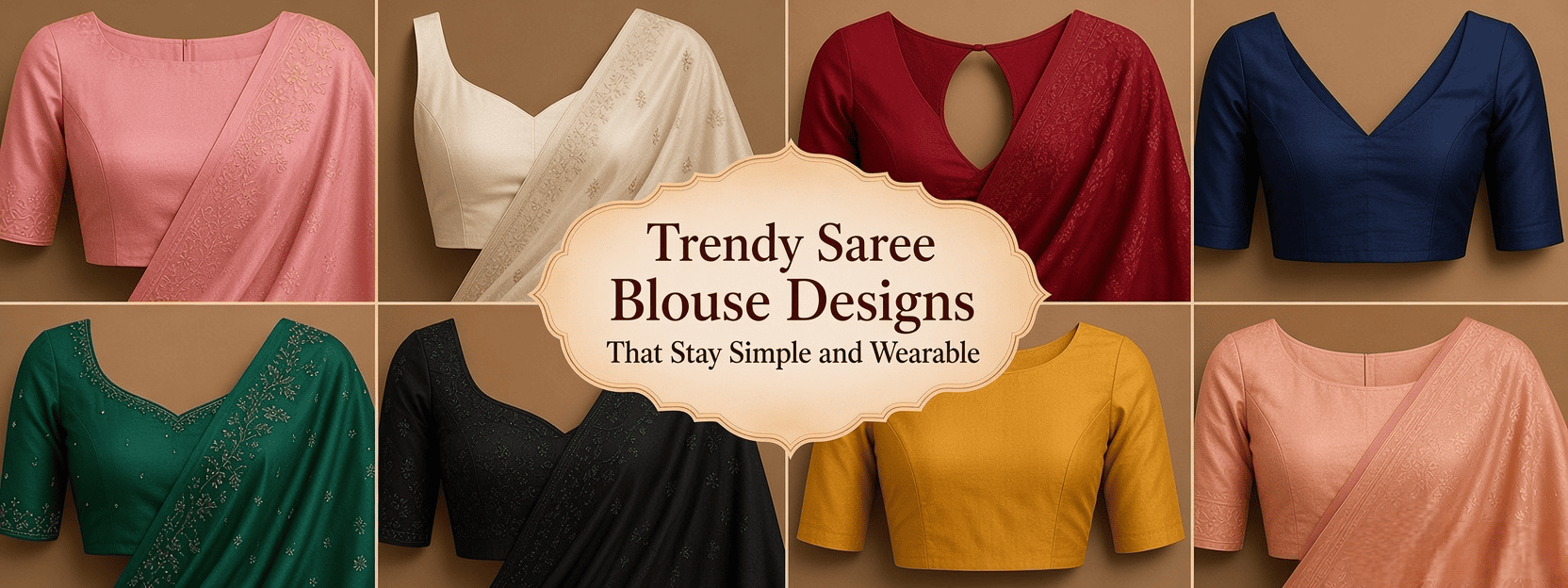
Trendy Saree Blouse Designs Ideas That Stay Simple and Wearable
The blouse sets the frame. Neckline changes how long the neck looks. Sleeve length changes how formal the outfit feels. The back decides whether you can wear your hair up. Fabric decides whether you survive a summer wedding or a winter reception.
A simple blouse also ages better. Heavy trends date quickly. A well-fitted cotton or silk blouse with a strong neckline can move from a festival to a dinner without looking costume-like.
The useful question is not “what is the most decorated option.” It is “what will sit well with this particular saree and this particular day.”
Necklines That Do Most of the Work
Start here. The neckline is the first thing people notice when you drape the pallu.
Round neck remains the safest everyday choice. It sits cleanly under most borders and does not compete with a busy pallu. It works on almost every age and body type.
Boat neck gives a wider, more elegant line across the shoulders. It is especially useful if you want the saree to feel slightly more contemporary. A contrasting border along the neckline is enough detail; you rarely need more.
Square neck looks structured and a little sharper than a round neck. A small amount of beading or a clean finish is usually plenty.
V-neck and U-neck lengthen the torso. They are reliable when the saree has a heavy border or when you want a slightly more open look without going backless.
High neck works when you want coverage and still want the blouse to feel finished. Keep embellishment light or the whole thing starts to look crowded.
Halter and off-shoulder shift the outfit toward fusion. They suit lighter sarees, pre-draped styles, and events where you want the blouse to be part of the statement. They are less practical if you need the pallu to stay firmly on the shoulder all evening.
Cowl neck adds soft draping at the front. It is a good option when the saree itself is plain and you want interest without embroidery.
Keyhole at the front or back gives a small, controlled opening. It reads as intentional rather than revealing.
Choose the neckline against the saree, not in isolation. A heavily embroidered saree usually wants a quieter neck. A plain silk or cotton saree can take a stronger shape.
Sleeves: Comfort First, Then Shape
Sleeveless blouses are the default for heat and for showing bangles. A thin embroidered or piped edge keeps them from looking unfinished.
Puffed and balloon sleeves add volume without requiring surface work. They suit cotton and lighter silks. They can overwhelm a very petite frame if the puff is too large.
Bell sleeves and ruffled sleeves introduce movement. They photograph well and feel festive even on a plain fabric.
Lace or sheer sleeves change the mood immediately. They work best when the rest of the blouse is solid, so the transparency has somewhere to contrast.
Cape sleeves add a formal, slightly dramatic line. They are better for evening events than for a long day of moving around.
Cold-shoulder cuts are still around, but they need a confident fit. If the cut is sloppy, they look accidental.
Sleeve length also changes formality. Elbow or three-quarter often feels more polished than full length for daytime functions. Full sleeves in velvet or brocade read as winter festive.
If you are unsure, a clean short sleeve or a well-finished sleeveless cut is harder to get wrong than a complicated sleeve.
The Back Is Often the Most Interesting Part
Many people keep the front simple and put the design at the back, which makes sense. You see the front while draping; others see the back when you walk.
A buttoned back has a quiet vintage quality. Interesting buttons do more than extra embroidery would.
A dori or tie-up back is traditional and adjustable, which helps if your weight fluctuates or you share blouses.
Deep U-back and backless with a tie are bolder. They work when the saree is securely draped and you are comfortable with the exposure. They are not the best choice for windy outdoor functions or if you need the pallu to stay put.
Sheer back panels add a modern note while keeping some coverage.
A small keyhole is the middle path: a hint of detail without committing to a fully open back.
Whatever you choose, the fit around the band and the armholes matters more than the decorative idea. A beautiful back that gapes or rides up will not look expensive.
Details That Stay in the Background
Simple does not have to mean blank.
Useful, restrained details include:
- Narrow embroidered or zari borders
- Contrast piping that follows the neckline or princess seam
- A single line of pearls or beads
- Kantha, thread work, or light mirror work on the edges
- Scalloped hems
- A bow, a few tassels, or a clean zipper as a design line
- Pintucks or light pleating for structure
These work because they catch light without covering the whole blouse.
Heavier options — full sequins, dense zari, brocade all over — stop being “simple.” They have their place on a wedding or reception blouse, especially with a plainer saree. They are usually the wrong choice if the saree already has a lot happening.
Appliqué, ikat, and tie-dye can look current on cotton or mul, especially for daytime or casual festive wear. They feel forced on a formal Kanjeevaram or Banarasi.
Fabric Changes the Entire Outfit
Cotton is still the most wearable daily and daytime festive option. It takes puffed sleeves, pintucks, and simple embroidery well. It also survives heat.
Silk (including raw silk and lighter satins) is the default for occasions. A plain silk blouse next to a rich saree often looks more expensive than a matching overworked one.
Velvet belongs to cooler weather and evening events. Keep the cut clean; the fabric already has presence.
Brocade is festive by itself. A brocade blouse with a solid silk or georgette saree is a classic combination.
Choli-cut and Angrakha-style wraps are silhouettes more than fabrics. The wrap style is comfortable and has a traditional line that still photographs well.
Match fabric weight to the saree. A stiff brocade blouse under a fluid chiffon can look disconnected. A flimsy cotton under a heavy silk can look underdressed.
Pairing the Blouse With the Saree and the Occasion
A few combinations that consistently work:
- Heavy silk or Banarasi saree → plain or lightly bordered blouse in a related or contrasting solid
- Printed or ikat saree → solid blouse that picks one colour from the print
- Plain pastel or solid saree → boat neck, square neck, or a blouse with one interesting sleeve or back
- Casual cotton saree → puffed sleeves, tie-dye, or a simple collared blouse
- Wedding guest look → silk or brocade, modest neckline, refined back detail
- Long daytime function → cotton or raw silk, comfortable armhole, sleeve you will not tug at
Contrast is useful, but it should be deliberate. A completely unrelated bright blouse can look stylish or chaotic depending on the rest of the jewellery and the pallu drape.
Also consider jewellery. A high neck or heavy collar blouse usually wants simpler necklaces. A deep neck or open back leaves room for a statement piece.
Common Mistakes That Flatten a Good Saree
The blouse is too tight across the back or armhole, so it wrinkles the moment you raise your arm.
The neckline is so low or so wide that the saree cannot sit securely.
Every surface is decorated, so nothing has a place to rest.
The blouse fabric is a different “temperature” from the saree — very shiny against a matte handloom, or very rustic against a formal silk.
The length is wrong. Too short and the midriff gap looks unintentional; too long and the drape bunches.
Copying a celebrity blouse without checking whether your saree, your height, and your event are similar.
A good tailor or a careful ready-made fit solves more problems than a new “trend” will.
How to Decide Without Overthinking It
Look at the saree first. If it is busy, quieten the blouse. If it is plain, give the blouse a clear shape.
Decide how much skin you actually want to show for that event, then choose the neck and back accordingly.
Pick a fabric you will be comfortable in for the full duration — not just in the trial photo.
If you already own several heavily worked blouses, the next one that will get the most wear is probably a well-cut solid in a colour that matches more than one saree.
Trendy saree blouse designs right now are less about inventing a new shape every season and more about editing: cleaner necks, better sleeves, thoughtful backs, and fabrics that feel good. The blouses that last are the ones you forget you are wearing after the first hour.
If you are planning a new piece, take the saree to the tailor (or keep clear photos of its border and pallu). Ask for a muslin trial if the neckline or back is unusual. That single step prevents most disappointments.
Frequently Asked Questions
What blouse works best with a heavily embroidered saree?
A solid or lightly bordered blouse in a matching or contrasting colour. Let the saree carry the work.
Which neckline is the most versatile?
A classic round neck or a moderate V-neck. Both sit well under most pallus and jewellery.
Are backless blouses practical?
They can be, if the saree is draped securely and the event is indoors or still. They are a poor choice for wind, travel, or if you need the pallu on your shoulder the whole time.
What should I wear for a casual outing in a saree?
Cotton or mul, sleeveless or short puffed sleeves, minimal surface work. Comfort will show.
How do I make an old blouse look more current?
Change the neckline, add contrast piping, replace tired hooks with a clean zipper or better buttons, or recut the sleeves. Sometimes only the back needs updating.
Do simple blouses work for weddings?
Yes, especially in silk, raw silk, or brocade with a strong cut. A simple blouse next to a rich saree often looks more refined than two competing embroidered surfaces.